
天气预报
How can enterprises embrace AI transformation? ‘5A Framework’ unveiled_我的网站

一 |
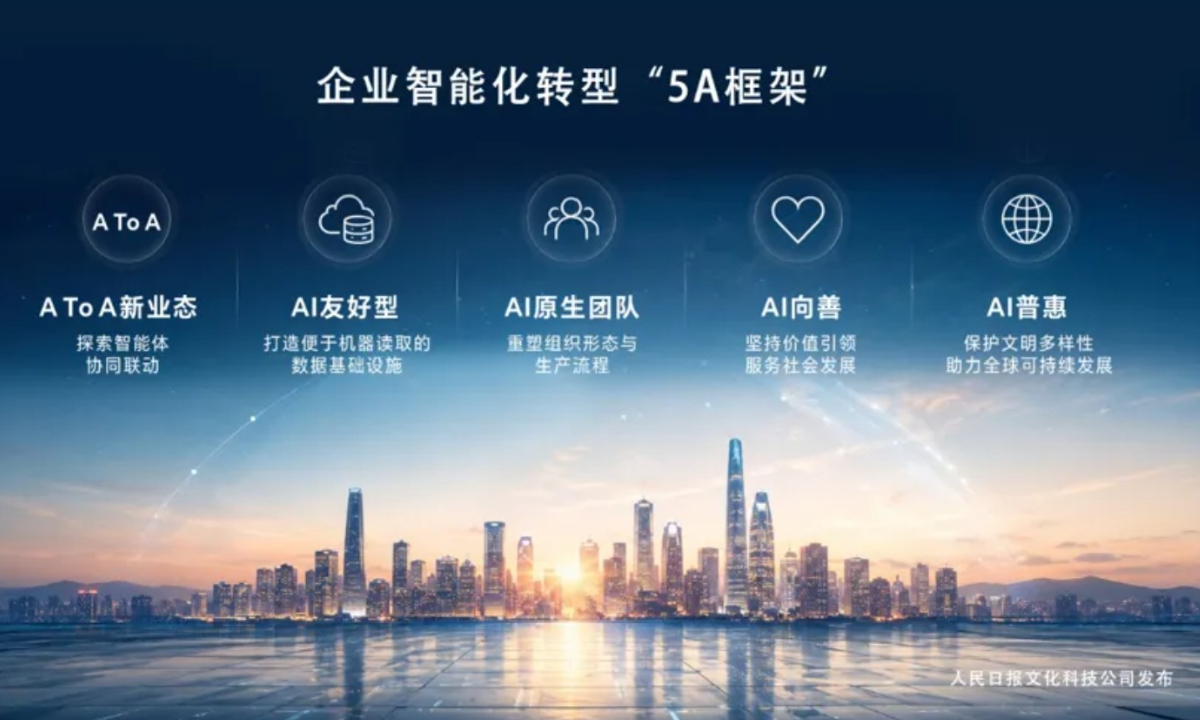
The 2026 Digital Intelligent Economy Forum was held in Langfang, North China’s Hebei Province, on Wednesday. At the forum, organizer People's Daily Cultural Technology Corporation unveiled a “5A Framework” for enterprise intelligent transformation, aimed at helping businesses comprehensively innovate their business models, organizational structures and service systems in the artificial intelligence (AI) era.
A To A: Exploring new models for agent collaboration
AI is pushing the internet into a new stage characterized by the widespread participation of AI agents. In the future, China could develop an ecosystem comprising tens of billions of agent applications, while the global “digital population” could reach hundreds of billions. Following To B (business-oriented) and To C (consumer-oriented) models, enterprises and institutions should actively explore the emerging To A (agent-oriented) model. To enable better interaction and coordination among agents, unified data, technology, interface and service standards need to be established, while new business systems and service models should be cultivated.
AI-friendly: Building machine-readable data infrastructure
Today’s internet user interfaces are primarily designed for human browsing. The first step, therefore, should be to build an “AI-friendly” data system that is better suited to being read, understood and accessed by AI. By structuring content resources and turning them into organized knowledge, while strengthening ontology systems and knowledge graphs, such a system can improve AI’s ability to understand and apply information. On this basis, integrated hardware and software infrastructure combining computing architecture with data systems can be developed for AI applications.
AI-native teams: Reshaping organizations and workflows
AI is profoundly reshaping organizational structures and ways of working. AI-native teams should redefine job responsibilities, organizational structures and business processes around the A-To-A model and AI-friendly services, enabling “everyone to have multiple AI agents.” Professional capabilities and business experience can be encapsulated into “digital employees,” promoting autonomous learning by agents, multi-agent collaboration and the evolution of collective intelligence, thereby multiplying per-capita productivity.
AI for good: Putting values first, serving social development
AI also requires values-based guidance. Guided by the principle of “being people-centered and using AI for good,” efforts should follow the approach of “governing AI with AI and guiding intelligence with wisdom,” ensuring that AI always serves social development, the public interest and people’s needs. The “Mainstream Values Corpus,” whose development was launched by the People’s Daily in May 2023, has already begun to take shape and has been validated through numerous large-model applications.
Inclusive AI: Protecting cultural diversity, advancing global sustainable development
AI should not become merely “a game for rich countries and rich people,” but should benefit all countries. Efforts should be made to actively participate in global initiatives for inclusive AI, bridge the digital and intelligent divide, and enable more organizations and individuals to share the benefits of development on an equal footing, so that AI can truly become a powerful positive force for improving the well-being of all humanity and advancing human civilization.
This was translated and compiled by the Global Times, based on an article originally published on people.cn on August 12, 2026.
。 AI摘要 厦门发力具身智能灵巧手赛道,本土企业研发仿生灵巧手,链主企业因时机器人落地。当地出台三年行动方案,推动技术攻关与场景应用,探索商业闭环,加速产业创新发展。 因时机器人的灵巧手在穿针引线。

二 | (因时机器人 供图) 灵巧手,被视作机器人进入现实生活的“最后一厘米”,在这条赛道上,厦门的创新力量正在崛起。

三 | 近日,未来人(厦门)人工智能有限公司(以下简称“未来人智能”)宣布研发了一款仿生灵巧手——“未来人·启元”,为高校实验室提供从底层硬件到上层算法的全栈式科研平台。 与此同时,厦门围绕灵巧手精准招商,引入链主企业。国家级专精特新重点“小巨人”企业——北京因时机器人科技有限公司(以下简称“因时机器人”)近期落地集美,在厦门软件园三期建设国际业务总部和区域总部。 这些动态背后,彰显厦门向具身智能技术深水区挺进的决心。

四 | 当前,厦门正深入实施创新驱动发展战略,推动科技创新和产业创新深度融合,切实把人工智能这个关键变量转化为加快创新驱动发展的最大增量。

五 | 近日印发的《厦门市具身智能产业发展三年行动方案(2026—2028年)》提出,要研发高性能仿生多指灵巧手,适配工业、服务等领域应用。

六 | 转魔方捏针 这双“巧手”都能完成 未来人智能的办公桌前,研发人员正对一只仿生灵巧手进行测试。

七 | “这只手,其实是按照我的右手1∶1复制出来的。”公司创始人陈伟山边说边与它击掌。 时间回到2022年,已有多个项目经验的陈伟山,带着“AI诊脉”的智慧医疗梦想再创业,算法模型搭好了,却在寻找适配硬件时碰壁。“市场上买不到合适的,那就自己造。”凭着这股倔劲,他一头扎进具身机器人赛道。历经近四年打磨,团队完成“模型+数据+本体”的系统研发,“未来人·启元”灵巧手由此诞生。 陈伟山介绍,灵巧手的“灵”源于更灵活的关节和更高的自由度,但这要求在极有限的空间里嵌入更多驱动器,对于电子控制、供电板和训练都是极大的挑战。面对这一难题,“未来人·启元”采用“云-边-端”架构,以“绳驱、连杆、齿轮”三合一传动结构破局。

八 | 整手仅重1.5千克,却实现手指独立驱动与多主动关节协同,运动灵活度达47个。此外,为适应多种极端环境并确保使用寿命,公司还与合作方共同研发高强度复合纤维线与特种塑料等材料。

九 | 在实测中,这双“巧手”可胜任转动魔方、捏针、轻握鸡蛋而不破等精细作业。 在商业化探索上,“未来人·启元”计划先向高校和科研院所推广。

十 | 陈伟山表示,公司将提供一站式服务方案,设备通电即可开展训练,并支持与用户共同完善仿真模型。

十一 | 当然,从发布到规模化商业应用,中间还有很多路要走。陈伟山表示,公司已启动新一轮融资,计划建立量产线,力争在灵活性、成本控制、可靠性三者之间找到平衡点。 领军企业落地厦门 拓展应用场景 此前,在央视春晚小品《奶奶的最爱》中亮相的“孙辈”机器人,凭借流畅、敏捷的变魔术动作引发关注。赋予机器人这份精准操作能力的“灵巧手”,就来自因时机器人。今年7月,该企业国际业务总部与区域总部——厦门因时机器人科技有限公司(以下简称“厦门因时”)在厦门软件园三期注册成立。 因时机器人成立于2016年,通过“仿人五指灵巧手+微型伺服电缸”双轮驱动战略,已深入机器人、工业自动化及医疗等众多行业。其自主研发的仿人五指灵巧手是国内首款商业化量产产品,2025年全球出货量突破1万台,位居全球首位;核心部件微型伺服电缸年产能达50万台,技术性能达到国际领先水平。

十二 | 记者了解到,因时机器人的微型伺服电缸直径仅十几毫米,作为灵巧手实现精密运动的“肌肉”,决定了手指的抓握力量和精度,在工业智造领域展现出广阔的应用前景。以新能源锂电生产为例,涂布工艺直接决定电池良率,因时机器人将小体积、高精度的微型伺服电缸嵌入涂布模头,结合测厚数据实现涂覆过程的实时动态微调,成功解决了长期依赖进口部件、无法在线纠偏的难题。目前,该方案已在多家头部动力电池企业的产线上批量部署,大幅提升了电池A品率。 “厦门集美集聚的精密制造和新能源产业与我们的上下游高度契合,便于就近配套,同时依托外贸口岸优势,能更高效地服务全球客户。”相关负责人表示,厦门扎实的工业基础和旺盛的智能化需求,为具身智能提供了绝佳“练兵场”,厦门因时前期将重点聚焦应用交付,公司希望以厦门为支点,探索更多灵巧手和微型伺服电缸的商业化落地场景,进而向全国乃至全球复制拓展。 跨越量产门槛 打通商业闭环是关键 近年来,随着具身智能产业的加速演进,灵巧手赛道热度持续攀升。

十三 | 北京、上海、广州、深圳、杭州等多个城市将灵巧手作为具身智能产业布局的重要抓手。

十四 | 据创投数据服务商IT桔子不完全统计,2025年国内灵巧手赛道融资总额达168.77亿元,仅2026年上半年,这一数字便已突破250亿元。 业内人士指出,灵巧手行业正迎来商业落地的拐点。市场竞争不再单纯比拼纸面参数,而是较量量产交付、产品可靠性及场景适配度。当前,企业的长期竞争壁垒越来越清晰,既需要掌握底层核心零部件的自研能力,也需要跨越规模化量产门槛,确保产品的一致性与耐久度。 从应用场景来看,短期内,工业场景、科研实验以及人形机器人验证,将是灵巧手率先实现规模化放量的领域;从中长期来看,随着具身智能技术的成熟,灵巧手的应用边界将逐步向服务、特种作业、医疗辅助等更为复杂的场景拓展。 面对这一产业风口,有业内人士建议,厦门不仅要鼓励企业和高校合作,推动仿生灵巧手核心技术的攻关,更要着力破解商业闭环难题。例如,可探索借助RaaS(机器人即服务)模式,即按需付费、以租代买,结合本地工业制造与文旅场景资源,让灵巧手及操作系统在真实场景中开展小批量运行,以“用”促“研”,加速商业落地。(厦门日报记者 林露虹)。
Current article:http://www.laojiusidaosenleliao.bond/list_of9qy0c/3q9a.xls
Published on:04:34:55


1
桐昆股份:上半年净利润42.22亿元 同比增长285.03%2
Japan's exports rise and imports decline in September3
台湾地区基层公职人员“九合一”选举启动4
江西银行回应“爱她就贷她回家”:本行没有“彩礼贷” 将依法维权5
字节跳动发布“豆包工作”,与飞书深度打通6
蛇年到,福运到——东城中心幼新春祝福7
从“害羞狂奔”到1500米耐力赛,机器人一天多次刷新人类纪录8
女游客拒绝男子搭讪遭辱骂 警方:行政拘留十日9
鸿蒙智行尚界 Z7 Allroad 车型首曝,预计下半年正式亮相10
世界杯之后,卡塔尔怎么样了?11
超级个体的创意工作室来了!腾讯AI创意智能体Miora全量上线12
海外业务有何影响?医药外包板块重挫,千亿巨头跌停,多家公司回应_生物_美国13
中国人,“入侵”新加坡的夜生活14
대법, ‘서부지법 폭동’ 가담자에 11억원대 소송…“사법독립 위협”15
总有没去过的!新加坡这12个新公园必去!遍布全岛,徒步骑行友好
- 随机推荐
1
外交部谈机器人大会:中国底层逻辑始终是开放合作、互利共赢 而非封闭独占2
已攻入17球,奥亚萨瓦尔刷新个人单赛季最多进球纪录3
트럼프, 사우디 원자력협정안 의회로…우라늄 농축 허용 놓고 논란[1일1트]4
2026北疆秋季旅游攻略:核心景点推荐及喀纳斯深度游玩路线住宿指南5
小米手机售后规则再调整,删除二手产品 / 商品不属于三包范围相关表述6
常胜生物:接到深圳证券交易所强制退市决定7
饮料市场健康化趋势加深:中式养生水、无糖茶成增长新动能,饮料市场健康化趋势加深:中式养生水、无糖茶成增长新动能8
痛心!19岁失联女大学生姜宏宇遗体被找到,警方通报,死因曝光9
QQ音乐买年卡仅用一周,退余额遇霸王条款且客服沟通难10
EV制造商Arrival再次裁员并将业务重心从英国转移至美国11
小米印度总监称赞中国的高速铁路:如果它在印度推出,城市间旅行将是一个新的。12
中国汽研与延锋国际签署战略合作协议13
华为新机曝光,号称中端机杀手2.0?14
Venezuelan artist Osvaldo Vegas's retrospective held at Guangdong Art Museum15
网约车被运政部门追赶致2死1伤?西安警方辟谣