

个人简介
生死狙击


推荐博文
冰与火之歌第一季
2026-08-26
分类: 俯卧撑
冰与火之歌第一季
PLA Army fields new wheeled armored vehicles in Gobi Desert_我的网站

一 |
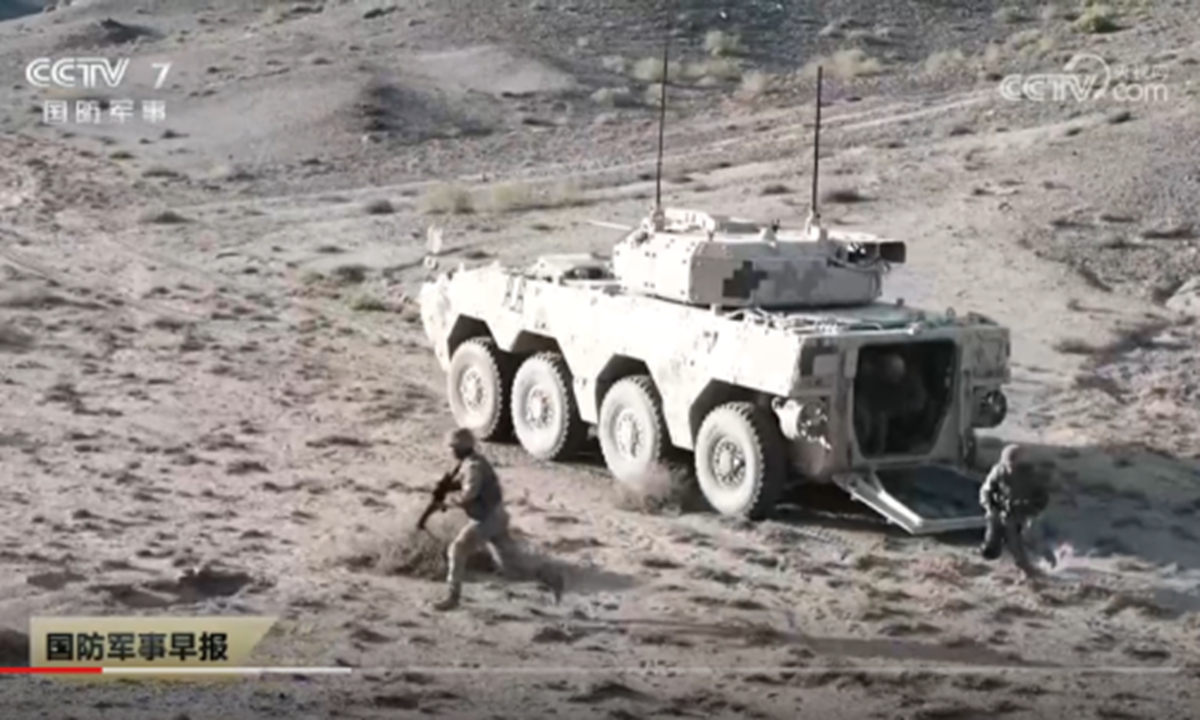
In the CCTV News footage, a brigade from the PLA Army's 76th Group Army was conducting autonomous coordinated training. Multiple new 8x8 wheeled IFVs were seen driving across the terrain, coordinating with troops to complete various tasks. The new 8x8 armored personnel carrier features an unmanned turret and anti-tank missiles, and its tailgate can be figured to open either sideways or downward.
In 2025, the company received new equipment. For the PLA soldiers, the challenge extended beyond changes in specialized skills to include upgrades in training models and combat concepts, said the report.
The new IFV is a deep redesign of the Type 08 wheeled armored vehicle family, with comprehensive improvements in firepower, protection, mobility, informatization and ergonomics, Zhang Junshe, a Chinese military affairs expert, told the Global Times.
According to a CCTV report in June, the vehicle has several new features: high mobility and speed suitable for all-domain operations; an unmanned turret offering wider visibility and higher automation, improved protection and crew safety; amphibious capability; long-range vehicle-mounted anti-tank missiles; and a flexible tailgate that can open either sideways or downward, combining both options in one design.
Compared with the Type 08, the new model has significantly enhanced firepower. It introduces an unmanned turret for the first time, improving survivability and freeing up interior space, while featuring a new-generation 30mm chain gun with adjustable firing rate. The anti-tank missiles have also been upgraded, enabling asymmetric strikes within enemy tank direct-fire range, Zhang said.
Protection has been comprehensively upgraded with thicker composite add-on armor, and structural improvements offer better resistance against mines and improvised explosive devices.
Mobility is also stronger, with better off-road climbing ability than the Type 08. Its informatized situational awareness and system integration capabilities are more advanced, and improved ergonomics enhance combat efficiency, said Zhang.
The vehicle has appeared multiple times in official media reports this year.Zhang said it is now entering mass deployment and may eventually replace the Type 08 as the core equipment of the PLA's medium combined brigades.
In January, CCTV reported on a coordinated tactical exercise involving an armored infantry squad from a brigade of the 76th Group Army, marking the vehicle's first public appearance.
Prior to its official debut, media outlets such as Hong Kong-based Ta Kung Wen Wei Media Group had analyzed the vehicle's capabilities based on online images, reporting that it features a remote-controlled weapon station, an unmanned turret, and four HJ-16 anti-tank missiles, delivering more powerful and precise firepower.
It adopts a hydraulic suspension system and incorporates signature-reduction measures to minimize infrared signatures, and can be fitted with composite armor to enhance protection and concealment.
Following a series-based, modular "vehicle family" development model, the vehicle's common chassis, in addition to the three existing variants, can be rapidly adapted into other configurations, comprehensively enhancing the medium brigade's combat effectiveness and long-range cross-regional mobility.
Compared with the current Type 08 wheeled armored vehicle family, these variants feature considerable differences in firepower configuration, chassis and hull layout, offering more flexible operational performance and superior protection, said Ta Kung Wen Wei.
Like the Type 08 family and the Type 11 Wheeled Assault Gun, the new IFV is expected to develop into multiple variants with different functions, forming a complete vehicle family.
Through this "one chassis, multiple variants, series-based development" approach, the new-generation will efficiently cover the full spectrum of combat elements - from command, reconnaissance and strike to support - significantly improving overall combat effectiveness and logistical support efficiency, Zhang added.
。 Are 3D mammograms better than standard 2D imaging for catching advanced cancers?A clinical trial is recruiting thousands of volunteers — including a large number of Black women who face disparities in breast cancer death rates — to try to find out.People like Carole Stovall, a psychologist in Washington, D.C., have signed up for the study to help answer the question.“We all need a mammogram anyway, so why not do it with a study that allows the scientists to understand more and move closer to finding better treatments and ways of maybe even preventing it?” Stovall said.The underrepresentation of women and minorities in research is a long-simmering issue affecting health problems including Alzheimer’s disease, stroke and COVID-19. Trials without diversity lead to gaps in understanding of how new treatments work for all people. “Until we get more Black women into clinical trials, we can’t change the science. And we need better science for Black bodies,” said Ricki Fairley, a breast cancer survivor and advocate who is working on the issue.Black women are 40% more likely to die from breast cancer than white women and tend to be diagnosed younger. But it’s not clear whether 3D mammography is better for them, said Dr. Worta McCaskill-Stevens of the National Cancer Institute.“Are there populations for whom this might be important to have early diagnosis?" asked McCaskill-Stevens. "Or is it harmful,” causing too many false alarms or unneeded follow-up tests and treatments?McCaskill-Stevens, who is Black, leads NCI’s efforts to boost access to cancer research in minority and rural communities. She has joined the study herself.The newer 3D technique has been around for a decade, but there’s never been conclusive evidence that it's better than 2D at detecting advanced cancers. The screening technique combines multiple pictures of the breast taken from different angles to create a 3D-like image. Both 3D and 2D mammograms compress the breast and use low doses of radiation.Prior studies suggest that 3D finds more cancers than 2D, but catching more cancers doesn’t necessarily mean more lives saved. Some cancers missed by standard screening may not progress or need treatment. Previous studies did not randomly assign patients to a screening method, the gold standard for research.The notion “that if it’s new, it’s shiny, then it’s better,” isn’t necessarily true, McCaskill-Stevens said. “Until we have the evidence to support that, then we need well-designed randomized trials.”The trial has enrolled nearly 93,000 women so far with a goal of 128,000. The NCI-funded study is now running in Canada, South Korea, Peru, Argentina, Italy and 32 U.S. states. A site in Thailand will soon begin enrolling patients.“We added more international sites to enhance the trial’s diversity, particularly for Hispanic and Asian women,” said Dr. Etta Pisano, who leads the study. Overall, 42% of participants are Hispanic. As recruiting continues, enrolling Black women and other women of color will “absolutely” continue as a priority, Pisano said.Participants are randomly assigned to either 2D or 3D mammograms and are followed for several years. The number of advanced cancers detected by the two methods will be compared.At the U.S. study sites, 21% of study participants are Black women — that's higher than a typical cancer treatment study, in which 9% of participants are Black, McCaskill-Stevens said.The University of North Carolina has signed up more Black women than any other study site. Nearly a quarter of the nearly 3,000 women enrolled at UNC’s two locations are Black.“Women in North Carolina want to take part in something that’s bigger than them,” said Dr. Cherie Kuzmiak, who leads the UNC arm of the study. “They want this active role in helping determine the future of health care for women.”In Washington, D.C., word of mouth has led to successful recruiting. A chance encounter at her hair salon persuaded Stovall to join the research. While waiting for a hair appointment, she met Georgetown University cancer researcher Lucile Adams-Campbell. The two, both Black, started chatting.“She explained how important it was to get women of color into the program,” said Stovall, who jumped at the chance to catch up on her mammograms after the COVID-19 pandemic delayed screening for her and thousands of others.For Stovall, there was a personal reason to join the research. Her sister recently completed treatment for triple negative breast cancer, an aggressive type that affects Black women at higher rates than white women. Women ages 45 to 74 without a personal history of breast cancer are eligible for the study, which launched in 2017. Many women also are providing blood and cheek swab samples for a database that will be mined for insights.“It’s a dream that people had since the beginning of screening that we wouldn’t fit everybody into the same box,” Pisano said. The study's findings could “reduce disparities if we’re successful, assuming people have access to care.”Stovall, 72, had a brief scare when her mammogram, the traditional 2D type, showed something suspicious. A biopsy ruled out cancer.“I was extremely relieved,” Stovall said. “Everybody I know has heard from me about the need for them to go get a mammogram.”___The Associated Press Health and Science Department receives support from the Howard Hughes Medical Institute’s Science and Educational Media Group. The AP is solely responsible for all content.。
Current article:http://www.laojiusidaosenleliao.bond/hzqo/20260826/542214.doc
Published on:06:58:00
相关热门文章
- 知名舅舅党:《生化9》DLC或将有《生化1》洋馆
- 联想发布43.4英寸弧形丝带显示屏:32:10比例,售价约8000元。
- 恒润股份索赔时效只剩三个月 受损股民仍可索赔
- 中国福利彩票发行管理中心关于停止销售“联合销售15选5”等9款游戏的公告
- 美以如意算盘落空了,哈马斯开打后,两国方案是解决问题唯一途径
- 市委举行学习贯彻习近平新时代中国特色社会主义思想读书班暨市委理论学习中心组学习会议
- 太空视角看洛杉矶山火有多严重
- 《共鸣:瘟疫传说传承》泄露已有人通关!全流程约14小时
- Cybercab正式定档!自动驾驶赛道迎来新催化 这7股业绩倍增可期(名单)
- 重复接种加强疫苗或将不再需要 新分离抗体可中和目前已知新冠病毒株
- 9月11日天津新增阳性感染者活动轨迹公布
- 上半年广东文化服务业营收6511.63亿元,同比增长10.7%
- 《长城对话》新闻IP研讨会|赵永平:什么内容才是当下传播的“硬通货”?
- 今天首发!河北好物坐上专列,24小时直通福建
- 国台办:民进党当局应尽快取消限制 不要阻挡两岸影视文化交流合作


